2026-06-24
Contract renewal software: what it does and what to look for
What contract renewal software automates, how it differs from a contract management suite, and the checklist that stops a renewal slipping.
Contract renewal software is a tool that knows when every contract you have needs a decision - renew, renegotiate or cancel - and makes sure the right person hears about it early enough to act.
That sounds like one job, and it is. But people searching for it mean a few different things: renewal management, renewal automation, "something that auto-renews contracts". Some of those are worth paying for and one of them is a trap. Here is how to tell them apart, and what to look for.
What contract renewal software automates
It does not sign renewals for you. Renewing a client retainer, a lease or a software subscription is a business decision, and no tool should make it on your behalf.
What it automates is the watching. It holds every contract with its end date and its notice period, works out the dates that matter, and tells you ahead of each one, more than once, wherever you will actually see it. The thing that costs money is not a missing signature. It is a date nobody noticed.
Two meanings of "automatic contract renewal"
The clause. An auto-renewal clause rolls the contract into a new term unless one side cancels in time. Most retainers and almost every software subscription work this way. The clause moves the date you have to watch: not the end date, but the last day you can give notice. With a 90-day notice period on a contract ending in March, the decision is made in December.
The software. Renewal automation software automates the reminders around that clause - not the renewal itself. If a tool promises to "automatically renew" on your behalf, ask what exactly it is doing, because the part you want to keep is the decision.
When you are the supplier, the clause is mostly good news: the work continues without a new signature. When you are the customer, the same clause charges you for another year because nobody flagged the cancel-by date. Contract renewal software has to cover both sides.
Renewal management software or a contract management suite?
Contract management suites (CLM) draft, negotiate, approve and sign contracts, and renewal alerts are one feature among many. They are built and priced for legal teams, and setting one up is a project.
Renewal management software does one part of that job: it knows the dates and makes sure each renewal gets a decision in time. For an agency, a consultancy or a small company with a few dozen client and supplier contracts, that part is usually the whole need.
What to look for
A contract renewal tool worth paying for should:
- Count from the notice deadline on any contract that renews by itself, not only from the end date
- Warn you more than once - around 90, 60, 30 and 7 days ahead - so the first alert leaves time to prepare
- Reach the team, not one inbox - email plus Slack, Teams or another shared channel
- Track where each renewal stands - contacted, negotiating, renewal sent, renewed or lost - so nobody chases the same client twice
- Show the value at stake in the next 30 and 90 days, so you know which renewals deserve a call this week
- Cover subscriptions too - the software you pay for renews on the same rules as the contracts you sell
- Be running in minutes, ideally by reading the dates from the contract PDF instead of retyping them
How Expiro handles it
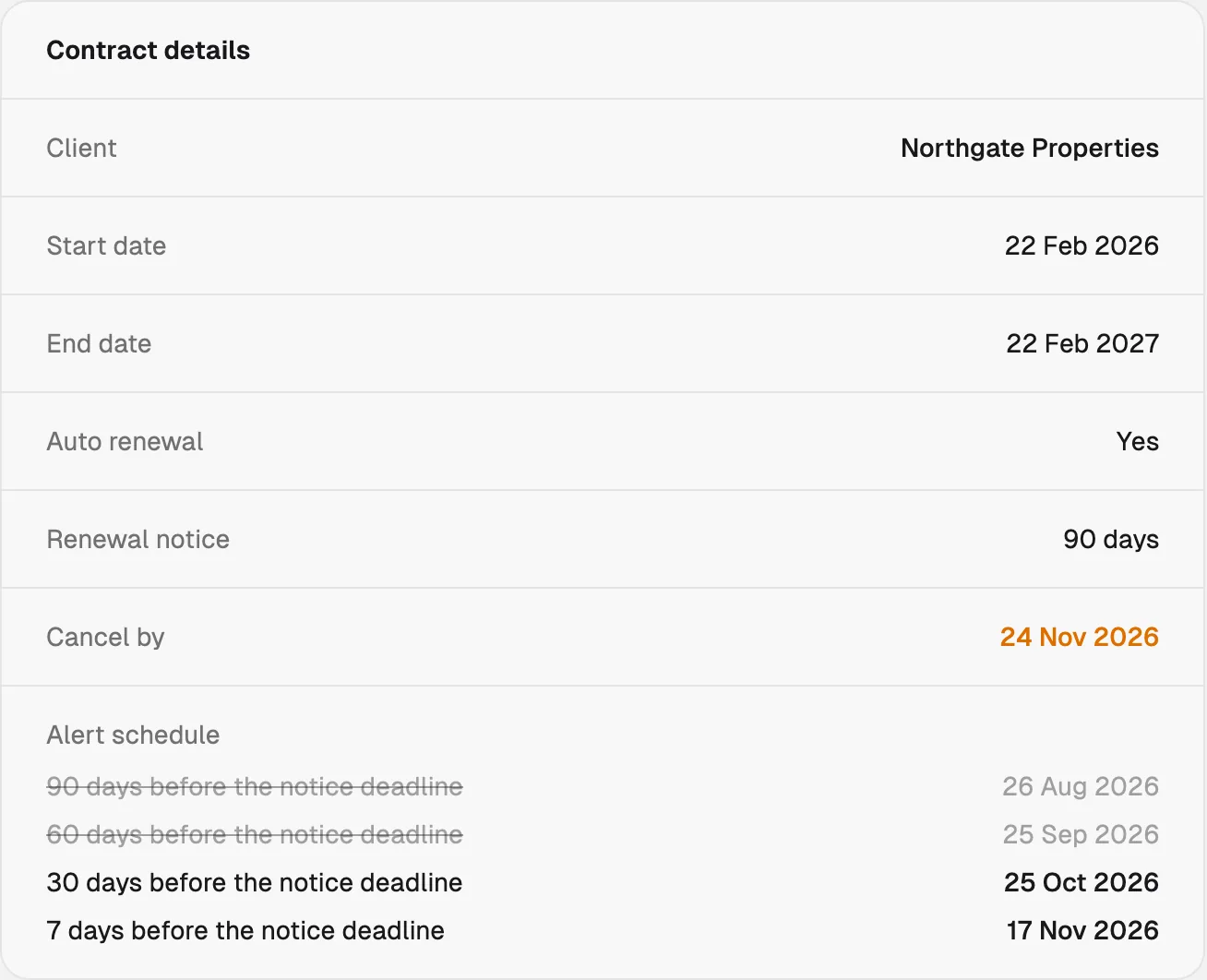
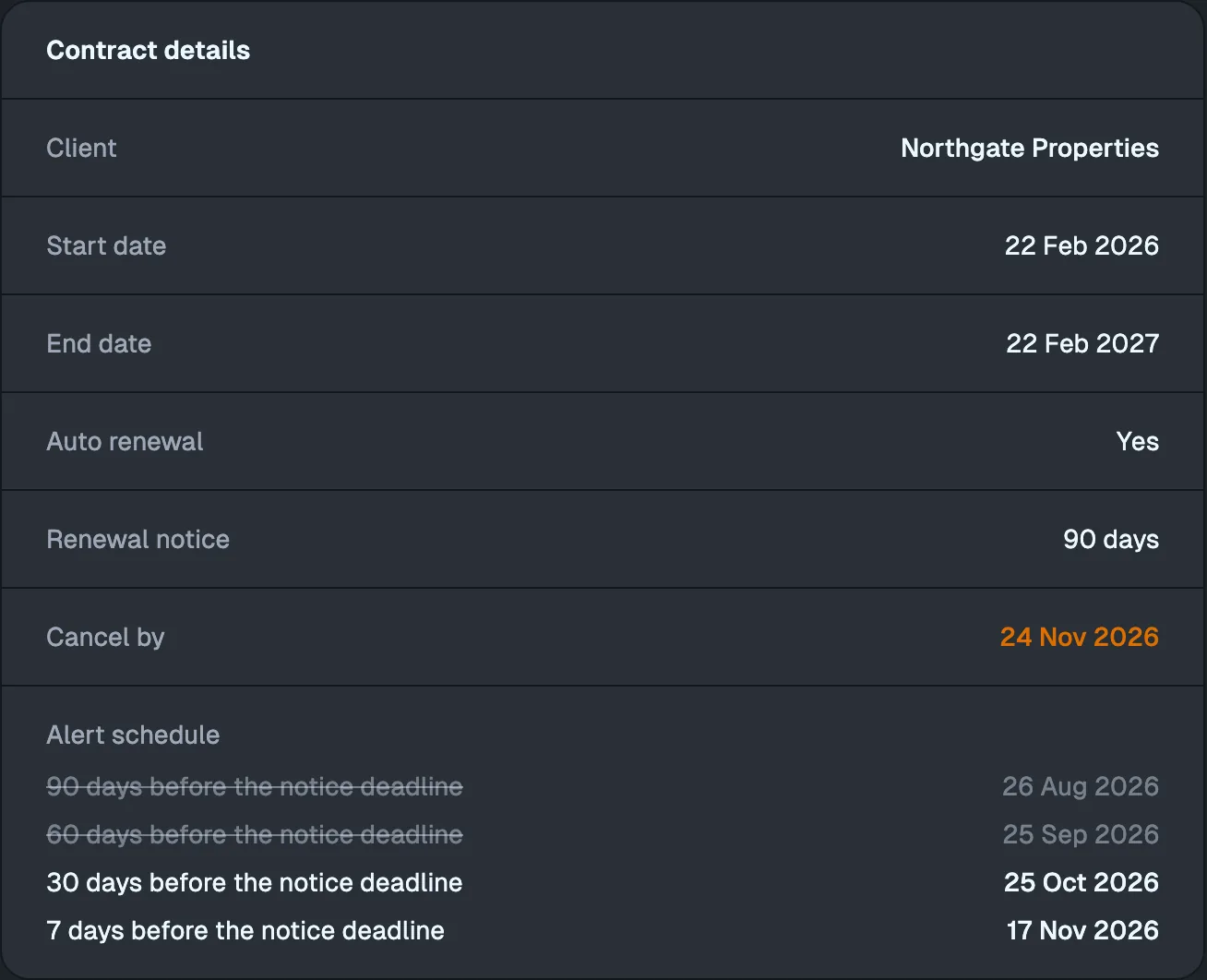
Expiro is contract reminder software built around exactly this. You add a contract with its end date and notice period, or let it read them from the PDF, and it works out the date that decides it. On a contract that renews by itself, every alert counts from the notice deadline; on one that does not, from the end date. Each renewal moves through a simple pipeline from upcoming to renewed or lost, and the dashboard adds up what is renewing next.
The screenshot at the end of this post is a real contract page with example data: an office lease that renews unless cancelled 90 days before it ends, and the four alerts counted from that deadline.
If you are still comparing tools, we wrote up what agencies should look for in a renewal tracker. Pricing is free for up to 5 contracts, then from $19 a month.
Questions people ask
What is the difference between contract renewal software and renewal management software? In practice nothing: both names describe a tool that tracks renewal dates and makes sure each one gets a decision. "Management" usually adds a status per renewal, which is worth having when more than one person deals with clients.
Is there software that renews contracts automatically? Some suites can generate a renewal document from a template, but the decision and the signature stay with people. What is worth automating is everything before that: the dates, the reminders and the hand-off to whoever owns the client.
Does it work for software subscriptions? Yes. A subscription is a contract with an auto-renewal clause and usually a short notice period. Track it like any other contract and the alert arrives before the next charge.
Never miss a contract renewal
Expiro tracks your contracts and sends email alerts before they expire. Free for up to 5 contracts, with 30 days of Growth to start. No credit card.
Start free →Keep reading
How to run a contract renewal audit in one afternoon
Find every contract that will renew without a decision. A step by step audit you can run this afternoon with a spreadsheet and no software at all.
The deadline before the deadline: tracking contract notice periods
The expiry date is not the date that matters. How to find the notice period in every contract you have signed and track it before it locks you in.
Tracking software renewals without a shared spreadsheet
A shared spreadsheet of software renewals goes stale the week after you build it. What to track instead, and what a tool has to do to be worth it.